Showing posts with label reviews. Show all posts

Friday, December 30, 2011

TLC Blog Tour - New


Published:  2011 by The Penguin Press
Source:  Received from Publisher for Review

  When I began reading New:  Understanding Our Need for Novelty and Change, I was expecting a diatribe about how today's consumer culture gives almost every product a limited life span to encourage more and more consumption.  This topic is touched upon, but instead what I found was a very interesting account of the value and importance of novelty in civilization.

  As the author, Winifred Gallagher, describes, neophilia (desire for novelty) has had an evolutionary purpose; it has helped civilization react to events or situations which in turn has led us to the world we live in today, for better or worse.  Using the example of Homo sapiens versus Neanderthals in prehistoric times, Gallagher notes that  Homo sapiens, as strong neophiles, were able to adapt to periods of potentially disastrous change and evolve into the "human race" as we know it today, while the Neanderthals, as neophobes (novelty-resistant), preferred the comfort of their insular surroundings, didn't interact with anyone else, and as result drove themselves into extinction.

  In the present era, novelty works on a spectrum.  There are extreme neophiles - those who are extremely sensitive to and distracted by new stimuli in their environment - and extreme neophobes - those resistant to any newness at all - but most of us fall somewhere in between.   It is a survival instinct to react to novelty and change (as Gallagher explains, a swerving car on the highway is a novelty in one's average existence and is thus reacted to as such) and how we determine an event on a separate danger spectrum is likely to determine how we react to it from a novelty point of view.

  Going into my preconcieved notion of the essence of this book, Gallagher does go into the consumer side of novelty and especially how in our present day novelty is represented by the latest gadget or even the buying experience itself.   This appears to be a relatively new phenomenon, which Gallagher compares to an almost religious experience:

By the lights of the old Protestant ethic consumer meant something like "spendthrift" or squanderer.  the avid customers queuing up for Black Friday sales and the latest Apple productcts, however, resemble religious pilgrims who prove their devotion by sleeping in front of the shrine on the night before they're permitted to purchase the Holy Grail.


  Related to this is Gallagher's thought that the pursuit of new "stuff" has resulted in society - specifically, American - losing touch with the purpose of novelty.  In today's turbulent economy, with young people fearful of what the future has in store for them; and the increasing number of seniors who are typically more conservative (and more neophobic), Gallagher notes:

All of these social influences contribute to a newly fretful America that's wary of original ideas that have uncertain outcomes, much less of active problem finding.


  Aside from the descriptions of studies on the science of novelty which I found uninteresting (I am NOT a science person), I found this book to be extremely interesting and a pleasant surprise to what I had originally expected.  The concept of novelty is much much more than material, and is more important than I had ever thought.


Wednesday, November 30, 2011

Falling for Me by Anna David


Published:  2011 by HarperCollins
Source:  Received from the publisher for review


  Once again, I am drawn to a project memoir that I was fully expecting to dislike, but am pleasantly surprised with how much I enjoyed.
   Anna David, a successful writer, has been unlucky in love one too many times and -- like many of us bibliophiles -- heads to the bookstore to search for that one perfect book that will cure everything that ails her seemingly bleak situation.  Her search appears to come up empty until she sees a pink cover on the shelf -- a copy of Sex and the Single Girl by Helen Gurley Brown.  The first line "I married for the first time at 37.  I got the man I wanted."  intrigues David and she purchases the book, but with the realization that is not likely to be a miracle worker:
I'm not the sort of person who transitions from a state of hopeless despair to one of zany optimism just because of a book - let alone some guide to living as a single girl in the 60's - so part of me wonders if I'm in a delusional state where I only think I feel better.  But I also know that I'm not really in a position to care.  This is the first time I've felt something other than miserable since my birthday, and these days, I'll take whatever I can get.

  And here is where I expected to start disliking the book.   I had preconceived notions of what a book written in the early 1960s would say about finding and keeping a relationship, and I didn't want to read about a woman in the present day changing herself just so that she could meet Mr. Right.  With some women, that may have been exactly what happened, but with David, what she learns about herself is much more than just how to get a guy.  For example, after some less than successful dates arranged through an online dating service, she realizes that her comfort zone is too small, she dusts off the Rollerblades that have been sitting in the closet and heads to the park to reacquaint herself with the activity; before she realizes, she is a fair distance away and is thrilled with herself and of the experience:
This place I've discovered because I'd forced myself to do something I'd long wanted to do, in other words, reminds me of some of the happiest times of my life.
 This experience resonated so strongly with me.  I've had the same types of experiences with things I've wanted to do but were afraid of trying because I thought it would be too hard; when I "just did it", the results were nothing but positive, even if there were some bumps along the way.  And in this sentence she sums this up beautifully:  "I can be whoever I want to be, provided I'm willing to not give up even when it's difficult." 

  In addition to expanding her comfort zone, David also picks up more domestic pointers from S&SG (as she refers to the book throughout her own); like how to cook a proper meal, how to decorate your home/apartment, how to "dress for success".  Ostensibly, these are improvements designed to impress a man, but to David they provide self-satisfaction; that you should be doing these things for yourself all along.

  Of course, the memoir does talk about David's adventures in dating and romance, and I found these parts to be uninteresting, even though I know they are a main point of the book.  However, I absolutely loved the overall message I took from reading it -- that anything you do should be done with you in mind first.

  Highly recommended.

  Here is a podcast interview with the author, Anna David (also available on iTunes)

Monday, November 28, 2011

Hamlet's Blackberry


Published:  2011 by Harper Perennial
Source:  Received from the publisher for review


  There are days when I pine for a smartphone.  The ability to be able to check my e-mail, Facebook and Twitter accounts wherever and whenever I wanted to seems like a good thing to me.  The fact that I check them several times during the day anyways on my computer and very little happens between each check  and that I rarely have my current "dumb" phone on and yet still rarely miss calls should be a sign that maybe that new shiny gadget isn't a priority in my life. 
 
  Reading Hamlet's BlackBerry has reinforced this justification to stay behind that trend-following curve, at least for a while longer.  William Powers is far from a technophobe and I think that is what makes this book so interesting and useful.  Not only does he take examples from his own life on his experiences in occasional "unplugging" (disconnecting from the Internet for entire weekends, for example), he also goes back into history and profiles the contemporary "technology" of seven great thinkers from Plato to Walden to Marshall McLuhan that provide lessons for us in the current era.  I especially appreciated his thoughts on Seneca, who encourages us not to allow outside distractions to disturb one's focus on the task at hand:
I force my mind to become self-absorbed and not let outside things distract it.  There can be absolute bedlam without so long as there is no commotion within.
For me, that means ignoring the e-mail and social media when I am in the midst of any work or personal project; and to give proper attention to the book I am reading now rather than think of the (many, many) other books sitting on my shelf that I want to read.  Right now that is still easier said than done -- old habits die hard -- but I am aware of these tendencies in myself and when I have made the effort to focus on the task at hand it is not as difficult to complete. 

Ultimately, technology is a great tool but should be used in conjunction with the other ones that civilization has given us over the centuries.

Highly recommended.


Monday, November 7, 2011

You are Not so Smart


Published:  2011 by Gotham Books
Source:  Received from the Publisher for Review

  Here's a newsflash:  it turns out that I am not so smart.

  Upon reading David McRaney's book, I discovered a few things about myself, some of which I might not have wanted to know.  He describes 48 different psychological principles that we all experience and which give us the illusion that we are always conscious of what we are doing.  For example:
  1. Apohenia -- My niece and I share the same birthday.  Coincidence?  Sure. Meaningful?  Just to me (and hopefully her, but she's only 5 and right now birthdays are all about her as it should be)
  2. Dunbar's Number -- I have over 500 followers and followees on Twitter (@bibliosue if you don't already follow me!) but I regularly interact with less than 10% of that group. 
  3. Procrastination -- When I add foreign films and documentaries to my Netflix queue I feel so smart and cultured, but when push comes to shove I either keep moving them down the list to get something more popular or I let the DVD sit in its sleeve for a week before giving up and sending it back unwatched.
   Of course once I read about the principles they make perfect sense, but because I now know that I am not so smart it will not prevent me from experiencing them; but I will be aware of them.

   At times I found the narrative to be a bit heavy with details of the various experiments used to prove these principles, but they are necessarily included to show their effects.  Apart from that I found You are Not so Smart to be an interesting and entertaining read and a book that I think could make for interesting discussions with the right book group.

  The publisher has provided a copy of You are Not so Smart to giveaway to a lucky commenter (US and Canada only -- sorry!)  Please leave your e-mail address in your comment and on Sunday November 13, I will randomly select a winner and contact them by e-mail.

  Thank you to TLC Blog Tours for allowing me to participate, and be sure to check out the other stops on this tour:
Monday, October 17th: Sara’s Organized Chaos
Tuesday, October 18th: Simply Stacie

Wednesday, October 19th: Luxury Reading

Thursday, October 20th: Girls Gone Reading

Friday, October 21st: Patricia’s Wisdom

Monday, October 24th: Overstuffed

Tuesday, October 25th: Today’s Path

Wednesday, October 26th: Unabridged Chick

Thursday, October 27th: 1330V

Tuesday, November 1st: Books, Movies, and Chinese Food

Wednesday, November 2nd: He Geek/She Geek

Thursday, November 3rd: Acting Balanced

Monday, November 7th: Bibliosue

Wednesday, November 9th: EvolutionYou.net

Thursday, November 10th: A Bookish Affair


Wednesday, October 19, 2011

Cutting for Stone


Cutting for Stone by Abraham Verghese
Published:   2010 by Vintage
Source:  Purchased

  Readers who selected this for the October "What Should I Read Next" poll:  THANK YOU.  

  I initially picked up Cutting for Stone last year, but got about 120 pages in and decided that it just wasn't the book for me at the time (read my post about that here).  So it went back on to Mount TBR, patiently waiting for the right moment.  I guess my mind must have been ready for it when I added it to the poll, because this time I didn't want to stop reading it and a few times found myself staying up past my bedtime to read just a little bit more.

  The novel begins with the surprising and traumatic birth of twins, Marian and Shiva Stone, at a hospital near Addis Ababa, Ethiopia, where their mother - a nun - worked closely with their father - the surgeon at the  facility.  Since it happens early in the book I don't think I'm spoiling anything by saying that upon their arrival they are abandoned by both of their parents in different ways, and are left to be raised by the remaining staff of the hospital compound, primarily doctors Hema and Ghosh.

  Told from Marian's perspective, the novel is the story of the twins' upbringing in Ethiopia, amongst the morally questionable officials and the beautifully described landscape (Verghese's descriptions of Ethiopia are so much in contrast to the only images I've seen of the country - depicting desolation and misery).  As twins, Marian and Shiva are very much in sync with each other, but they also have their own personalities and interests; as with any other sibling relationship, this creates some conflicts, especially in the area of women; specifically, Genet, the daughter of one of their household's servants who has grown up together with the boys.

  After some political turmoil in the country, the adult Marian - now a medical school graduate -  is forced to flee Ethiopia and finds his way to New York, where he takes on internship/residency at a hospital that closely resembles the hospital he called home in Ethiopia.  It is here that his past catches up to his present, and where his future is also at stake. 

  I won't say any more, because you just have to read the book.  It's not a short book -- over 600 pages -- but well worth the time and effort.  And the ending -- well, when you've finished it for yourself I'd love to talk about it; suffice to say that I had not expected what happened and was emotionally affected.

  Highly highly recommended. 


Wednesday, September 28, 2011

The Most Beautiful Book in the World


The Most Beautiful Book in the World:  Eight Novellas by Eric-Emmanuel Schmitt, translated by Alison Anderson
Published:  2009 by Europa Editions
Source:  Purchased

  I am by no means an expert about books, especially about books in translation; but since I do read a lot I am often asked by friends and colleagues to suggest something to read.  If I am ever asked to suggest a book in translation for someone who has not read one before, I will tell them to pick up The Most Beautiful Book in the World.  Immediately.

  Though the title of this collection comes from one of its stories (side note: they are referred to as novellas, but their length suggests short stories to me), it is an apt description for the entire book.  Each story is quite different, but all of them are engaging and - for me anyway - take you from happiness to sadness and back again all within a few pages.  Eric-Emmanuel Schmitt does an amazing job of creating interesting and identifiable female characters as well.  Several times I found myself in a story, because I could completely relate to the situation being faced.

  I can't claim a favorite story in this book because I really and truly enjoyed them all.  The good thing about a short story collection is that you can dip in and out as you have time; but I raced through all eight in an afternoon, and I know I will return to them.

  Highly recommended.

Monday, September 26, 2011

The Submission by Amy Waldman


The Submission by Amy Waldman
Published:  2011 by Farrar, Strauss and Giroux
Source:  Purchased (e-book)

  Few historical events have had the widespread impact of the attacks on September 11, 2001.  It seems everyone's life changed to some extent - from the minor inconveniences of airport security searches (my opinion:  they aren't a problem if you have nothing to hide) to the much greater effects of "average" Muslims being persecuted and the loss of family members and friends.  And it became an event that caused division and conflict, which Amy Waldman so wonderfully portrays in her novel, The Submission

  I loved this book.

  The book opens about two years after the attacks, where a jury of artists and political appointees are reviewing blind submissions for a memorial to the attack that will be built in New York City.  One of the members of the jury - Claire Burwell, widowed due to the attacks and the only family member on the jury - aggressively fights for one of the entries, a garden design.  Eventually, the jury agrees with her and votes for the garden, but when the name of the winning designer is revealed, all are shocked to find out that he is Mohammed Khan, American born and raised, but Muslim.
 
  So begins the conflict arising from this choice.  Although the jury is sworn to secrecy until they decide what to do about this issue, the name is leaked and Khan becomes a public figure to be denounced by anti-Muslim and 9/11 family groups and to be lauded by Muslim activists.  Mohammed (Mo, to his friends)  and Claire not only are the center of attention in this controversy, they are also conflicted within themselves, wavering between maintaining support for the garden or giving up and bow to the detractors. 

  Through the novel we see the issue from three other perspectives:  Sean Gallagher, the ne'er do well brother of a firefighter killed on 9/11 and who is now trying to do right by him; Asma Anwar, an illegal Bangladeshi immigrant whose husband - a custodian at the World Trade Center - was killed and who wants recognition of her loss; and Alyssa Spier, a journalist trying to establish her career on this story.  What I found so engaging about the novel is that Waldman weaves everyone's narratives together; so that even though you may be reading one perspective at a time, you also see one or more of the other characters and gain insight into their opinion as well.

  As I read this book, I was at times happy, sad and angry.  The whole issue of what constitutes a proper memorial and who has the right to create it becomes polarizing rather than unifying.  One reviewer mentioned that she wavered back and forth on who she supported, and while I didn't do that I can completely understand that feeling.  The novel does not provide answers,  but it does show that ugliness can reveal itself anywhere. 

  Highly highly recommended (and it would be perfect for book group discussions)


Monday, September 19, 2011

Far to Go by Alison Pick


Far to Go by Alison Pick
Published:  2010 by House of Anansi Press/Harper Collins Canada
Source:  Purchased

  This novel begins with a prophetic sentence:  "I wish this were a happy story."  Given that much of the narrative is set in Czechoslovakia at the time of Nazi occupation just before the beginning of World War II, one can immediately assume what type of unhappy story this will be; but it is more than that.

  The novel interweaves the narrative mentioned above - the story of Pavel and Anneliese Bauer, a prosperous Jewish couple who waver on sending their young son, Pepik, on a Kindertransport, and Pepik's nanny, Marta - with that of an unnamed narrator.  This narrator is a professor of Holocaust studies at a university in Canada and her area of interest is the children who were evacuated from Eastern Europe to England in the Kindertransports; she is obviously a lonely person and through her story we start to see the connection between this and her area of specialty.  She has a particular interest in the Bauer family, and she has kept a detailed file of their archived correspondence. 
 
  Marta is the focus of the historical narrative, and she is an interesting character.  Working for the Bauers after fleeing an apparently abusive home life, she finds comfort with them, and even though she questions the logic of her loyalty once persecution of the Jews begins, she realizes that the Bauers are the closest thing to a family she has known.  Pepik adores her - as she does him - and Pavel and Anneliese treat her as more than just a servant. 

  As the first sentence indicates, this novel is not a happy story.  That said, Alison Pick writes it so well that it is a pleasure to read - not only for the language she uses, and the interweaving narratives with copies of some letters from the archive; but for the mystery she creates, so even though you have an idea of the outcome, there are lingering questions throughout the novel that keep you reading. 

Highly recommended.


Tuesday, September 6, 2011

Just My Type: A Book About Fonts


Published:  2011 by Penguin
Source:  Received from publisher for review

  I consider myself to be a bit of a font geek.  Although my life in the real world that requires my writing production to be professional and (ahem) mature, I love playing with fonts on whatever report or project I am working on.  That said, I found my knowledge of fonts to be sorely lacking; the fascinating book Just My Type by Simon Garfield highlighted these gaps but rapidly filled them in for me as well.

  From the beginning of moveable type printing with Gutenberg's press, to the choice of fonts unleashed with Apple's Macintosh computer, Garfield describes the history and evolution of fonts, which is surprisingly rich:  for example, Nazi Germany's decision in 1941 to outlaw Gothic script - the traditional font used in Germany -   because of its association with Jewish bankers and Jewish-owned printing presses in addition to the lack of proper Gothic fonts in the countries they occupied.  There is also some really interesting stories about the use of fonts in branding -- for example, the fonts used in The Beatles' iconic logo and their album art; and the controversy surrounding IKEA's switch from Futura to Verdana in their signage and advertising.

  "Font piracy" is also discussed, which is something I never realized was an issue.  Owners of fonts do make money from licensing, but as Garfield notes:  "... if your font is any good, it gets copied."  And one of my favorite fonts, Arial, is deemed to be one of the biggest copies of them all - created by Microsoft as an alternative to Helvetica to save money on the licensing fees.  The differences in the two fonts are there but subtle but I suppose one could be mistaken for the other and that it must matter to some people.

  Included throughout the book are "fontbreaks", highlighting certain fonts and their creation and popular use,  and some (to me) incredibly insightful nuggets of information about symbols - I never knew that the ampersand (&) is a combination of the letters "e" and "t" (Latin for "et", which in modern French is the word for "and").  There is also a chapter devoted to the worst fonts in the world, which I'm sure in font-geek circles causes no end of heated discussion.

  Given my natural curiosity of seemingly-trivial topics, I thoroughly enjoyed this book and now find myself trying to guess the fonts on signs, posters, and other printed matter I encounter during my day. 

  Highly recommended.

  Be sure to check out the other stops on Just My Type's TLC Blog Tour:

  Monday, August 15th: Melody & Words
  Tuesday, August 16th: Mockingbird Hill Cottage
  Wednesday, August 17th: Chaotic Compendiums
  Thursday, August 18th: Books Like Breathing
   Monday, August 22nd: A Home Between Pages
  Tuesday, August 23rd: Steph and Tony Investigate
  Wednesday, August 24th: 1330V
  Thursday, August 25th: 2 Kids and Tired
  Friday, August 26th: Amused by Books
  Monday, August 29th: Unabridged Chick
  Wednesday, August 31st: Simply Stacie
  Thursday, September 1st: BookNAround
  Tuesday, September 6th: Bibliosue
  Wednesday, September 7th: Man of La Book
  Thursday, September 8th: My Book Retreat
  Monday, September 12th: Lit and Life
  Wednesday, September 14th: In the Pages


Monday, August 15, 2011

Summer at Tiffany


Summer at Tiffany by Marjorie Hart
Published:  2007 by Avon
Source:  Purchased

Do you remember the best summer of your life?

     So begins this wonderful memoir of an era that could easily be viewed as the best of times and the worst of times (apologies to Charles Dickens).

     It is 1945.  At the end of their school year at the University of Iowa, Marjorie Jacobson and her closest friend, Marty Garrett, head to New York City for the summer with high hopes.  Some of their sorority sisters have landed coveted jobs at the big department stores, and the girls want to join their ranks.  Turned away from them all ("Come back in the fall" they are told), in a very bold move they decide to call at Tiffany, one of the hallmarks of luxury then as now. 

     Thanks to the still-ongoing war in the Pacific, young men are scarce for filling positions, and the girls are hired as pages for the store's sales floor.  It is not the most glamourous job, but for Marjorie and Marty it is the opportunity of a lifetime.  They are provided dresses from Bonwit Teller (one of those much admired department stores) as uniforms, at times act as models of the jewelry in the showroom, and catch glimpses of celebrities.

     Outside of work, the girls have an active social life; their apartment in the city is party central for their sorority sisters coming in for the weekend from the outer boroughs.  And they meet new people as well that have the potential to change the course of their lives.  Marjorie, an aspiring cellist, meets a Yale music professor at the home of the girls' landlady who encourages her musical ambitions; and she meets a Navy sailor, Jim, who might be more than just a summer acquaintance.  
    
     What I truly loved about this book is that it re-created the time and the place so well.  I often say that I was born in the wrong decade and would love to go back in time to live in the 1940s and this book put me back there.  The innocence of these 20 year old girls -- "Good Night!" "Judas Priest!" "Oh my gosh!" were the harshest phrases coming out of their mouths -- and the simplicity of the era (despite the war raging overseas) is just wonderful to experience.  It's also entertaining to see how much prices and the value of money have changed over the years -- who wouldn't grab a dozen etched cocktail glasses from Tiffany for $12 these days?

     I also loved the element of suspense contained in the memoir -- at the end I found myself exclaiming "NO!" out loud, totally surprised at the outcome.

     Highly recommended.


Tuesday, August 2, 2011

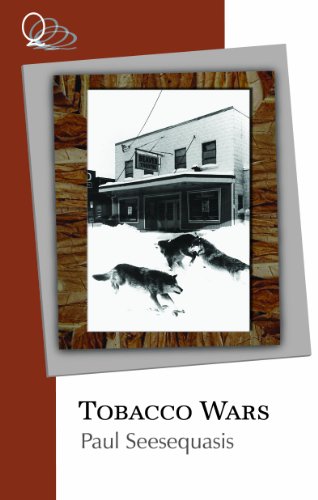
Tobacco Wars


Tobacco Wars by Paul Seesequasis
Published:  2010 by Quattro Books
Source :  Received from publisher as part of TLC Book Tour


  It shames me to say that I have not read much Native Canadian or American literature.  In fact, the only book that comes to mind that I have read is On the Rez by Ian Frazier, and that is  non-fiction written by an outsider.  So I was looking forward to reading Tobacco Wars and hosting a stop on the TLC Book Tour, hoping to introduce myself to a new genre of writing.

  Tobacco Wars is a novella with two narratives -- one of Pocahontas and her travels to London and relationship with Ben Jonson; the other an apparent Indian legend featuring a she-bear and a wolf pack.  Throughout both tobacco is mentioned, but frankly I did not see this as the main focus, which is what I expected given the book's title.  

  Again, I'm ashamed to admit that I don't know much about the real Pocahontas so I can't say how close or divergent this story is to the truth.  But it is interesting, and perhaps my own ignorance is revealed when I'm surprised at how well she is able to manage when she is in London.

  The legend part of the story, however, was not my cup of tea at all.  It seems to describe a creation -- of perhaps a nation, perhaps the entire world? -- but the way it is described is, well, crude and to me not pleasant to read.  Tobacco is introduced and the legend moves to tell of its influence on society even in the present day.  I think I understand what the author is trying to get at here -- oppression of Native populations fueled in part by the high demand for tobacco -- but I did not like the way he did it.

  Perhaps when and if I read more Native North American literature I will come back to this book with a better understanding of its background.

  Please make sure to visit the other stops on the tour:

Wednesday, July 13: Reading Lark

Thursday, July 14: Chaotic Compendiums

Monday, July 18: Truth, Beauty, Freedom, and Books

Tuesday, July 19: Jenny Loves to Read

Tuesday, July 26: Lit and Life

Wednesday, July 27: Man of La Book

Thursday, July 28: Man of La Book - author Q&A

Thursday, July 28: My Two Blessings

Tuesday, August 2: Bibliosue

Wednesday, August 3: Scandalous Women

Thursday, August 4: Life In Review


Wednesday, July 20, 2011

The Reservoir -- Review and Giveaway


The Reservoir by John Milliken Thompson
Published:  2011 by Other Press
Source:  Purchased at my local independent bookstore

  Once again I must give credit to the Books on the Nightstand Readers' Retreat (best weekend ever) for bringing a book to my attention that I likely would not have chosen on my own.  

  The Reservoir is a novel based on a true event that happened in Richmond, VA, in the late 1800s (the novel sets the year at 1885).     A young, pregnant woman is found lying dead in the town's reservoir and the investigation immediately begins to, firstly, identify her; and to determine her cause of death.  A "person of interest" is revealed right away -- Tommie Cluverius, who is described as fleeing Richmond to his family's home in rural Virginia almost immediately after the death is discovered.

  Of course it would not be a novel if the story ended there.  Tommie -- a young lawyer on his way up in the world -- is arrested for the murder of Lillie Madison, his cousin and occasional lover; and the novel goes back and forth between the preparation of the trial and the trial itself and the details of Tommie and Lillie's relationship.  Throughout these narratives we meet a host of interesting characters:  Tommie's brother Willie, loyal and willing to do anything to help his brother; the boys' Aunt Jane, Tommie's legal team, and the investigators of the death. 

  What I really enjoyed about this book was that the mystery lingered throughout the entire story.  Just when I decided the outcome, something happened to make me question that and change my mind, only for another twist to get me to return to my original thought.  Most importantly, these twists were not to my mind just devices thrown in to keep the reader interested, rather they were subtly included; and even now after reading the book twice I still cannot be sure I know what truly happened.
 
  This is an ideal book for both mystery lovers and for those interested in Southern fiction.  Highly recommended.

  Be sure to check the blog tomorrow for a guest post from John Milliken Thompson, The Reservoir's author.

  The publisher of The Reservoir, Other Press, has graciously offered a copy for giveaway to a lucky reader in the US or Canada (sorry, international readers).  Please leave your e-mail address in the comments below and the winner will be selected at random on Sunday, July 24.

Wednesday, July 13, 2011

The Most Beautiful Walk in the World


Published:  2011 by Harper Perennial
Source:  Received from the publisher for review

Paris belongs to its piétons – the pedestrians

   Regular readers of this blog, tell me:  is there any doubt as to what I think of this book?

   It's about Paris.  About walking in Paris.  About viewing the history of Paris on these walks through the eyes of some of the writers and other cultural luminaries who made their mark in the city:  Hemingway, Picasso, Sylvia Beach, to name just a few.  It's a book written by a Parisian resident who,  I think because he is not a native of the city,  still has a bit of the tourist in him to be able to express his wide-eyed admiration of the city and all that has happened to it.
 
  That's not to say that the book is all sunshine and roses about the city -- Baxter describes a few incidents typical of life probably anywhere, but for me, since they take place in PARIS, they seem so much more bearable. 

  Although not really a travel guide, for those interested in visiting Paris for the first or fortieth time is full of information disguised as narratives that would only enhance the experience;   my copy is covered in Post-It flags and highlighted throughout so that WHEN I can plan my next trip I will have new resources available to me.  Even for the armchair traveller, though, this book is simply a wonderful escape into one of the world's great cities.

  Highly recommended. 

  I also recommend another John Baxter memoir set in Paris:  Immoveable Feast:  A Paris Christmas; an account of his attempt to prepare a traditional French Christmas meal for his French in-laws.  A wonderful holiday read.


Tuesday, July 5, 2011

Quarantine by Rahul Mehta

Quarantine:  Stories  by Rahul Mehta
Published:  2011 by Harper Perennial
Source:  Received from publisher for review

  I have to admit that I have not read a lot of short stories and I don't know why.  The logical side of me thinks that having a book of short stories around would be ideal when I want to read but don't have enough time or inclination for something longer.  In addition, the curiosity seeker in me should be more inclined to short stories that allow me smaller glimpses into topics that spark my interest.

  This short story collection by Rahul Mehta, Quarantine, attracted me initially because of the fact the author is Indian-American and I am drawn to literature of the Indian diaspora (have I ever mentioned that I have eclectic tastes?).  This collection was made even more interesting (and curious) to me when I saw that it was about gay Indian-American men and I wanted to look into that life.

  My expectations of the stories were that they would be about families' shame and embarassment with having a homosexual in the family, but I was pleasantly surprised to see that this was not in any of the stories.  My pre-conceived notion of Indian families being rigidly conservative and not willing to accept anything outside of their traditional view of family life was definitely removed.  Though all of the stories have gay men as their main characters, the themes of the stories -- family loyalties, romantic relationships, cultural differences -- are ones that we all can relate to.  My favorite story of the collection is "The Cure", a story about a man who compulsively burns cash; to him, money does not change anything. 

  The stories might not be for everyone, as there are some explicit scenes, but they were for me a fascinating and eye-opening window into this community.  And I hope to find some more story collections to do the same.

  Recommended.

Thursday, June 16, 2011

Stories I Only Tell My Friends


Published:  2011 by Macmillan Audio
Source:  Purchased (audiobook)

  As a rule, I avoid celebrity books of any sort like the plague; partly because I am a mild book snob but also because I never see any that would interest me.  I don't care to read about the "troubles" of being a celebrity or whatever else they choose to write about, because most of the time they are just doing it for the paycheck.
 
  That said, I still was skeptical when I saw Rob Lowe had written an autobiography, but I thought I'd give the audio version a try because:  a.  I had a HUGE crush on Rob Lowe back in my teenage years; b. Rob Lowe narrates the audiobook; and c. I had heard favorable things about it.  Oh, and if I may be so shallow -- that cover photo is AWESOME.  Mr. Lowe is still a fine-looking man.

  So I spent about two weeks listening to it driving to and from work, and I absolutely LOVED it.

  This is a true autobiography.  Lowe starts almost right at the beginning, from his young years growing up in Dayton, Ohio, to his move to Malibu, California as a teenager with his mom and brother after his parents' divorce, to his start as an actor, his spectacular rise (The Outsiders -- what a great movie!), his fall (the sex scandal at the Democratic Convention in Atlanta, his battle with alcoholism), and his revival. 

  Through the highs he is generous with praise to those who helped him along the way, yet with the lows he does not really blame anyone but himself; even though it appears at times that there were those deserved blame.  It is an honest story of his life, where he admits he made mistakes, but also recognizes that he had and continues to have a very privileged life.

  And aside from his personal story, Lowe provides a unique insight into the entertainment industry.  He specifically highlights the process of making The Outsiders (did I mention that I loved that movie?), which was his "big break"; and his efforts to be cast in The West Wing.  For me, since I listened to the audiobook, what made these anecdotes that much more interesting was Lowe's pretty decent impersonations of his castmates. 

  Add some fascinating stories of his life in the fast lane (a brief relationship with Princess Stephanie of Monaco, for example) and an eerie connection to the 9/11 attacks and you have a book that is never boring.  This is the first audiobook I've listened to in a long time where I can say that my mind didn't wander once from the narration.

  And now I have to get on Netflix to put The Outsiders on my queue so I can relive my lost youth :-)

Highly recommended (especially the audiobook)

Thursday, June 2, 2011

Jerusalem Maiden by Talia Carner


Jerusalem Maiden by Talia Carner
Published:  2011 by Harper
Source:  ARC received from publisher for review

  Esther Kaminsky is an ultra-Orthodox Jewish girl in Jerusalem of the early 20th century, and as a result her role in life is simple:  to marry and have many children (preferably sons).  However, when her teacher notices Esther's talent for drawing and encourages her artistic talent, she begins a lifelong struggle with her obligations to family and faith and her desire for self-expression. 

  Esther definitely has rebellious tendencies, and merely by studying with her French teacher, Mademoiselle Thibaux, she would be causing shame to her family if they knew about it.  But her family is still central to her life, and when crises and tragedy strikes, her art is put aside; but it is always with her:

"You may have forbidden yourself to hold a pencil or a brush," Mlle Thibaux said, "but you can't change the way your eyes distinguish hues where everyone else sees merely bland colors.  You can't change the fact that you watch the world from a perspective unavailable to others.  You can't change the nature of the dreams that come to you at night."

  After an arranged marriage and the birth of her children, Esther seems settled and content with the life chosen for her.  But when she sails to Paris -- to meet up with her husband who has been in Europe on business -- the inner conflicts of her youth resurface. 

  Of course being the francophile that I am I loved the part of the book set in Paris the best; but it wasn't only the setting that I loved reading.  It's probably a cliche but when she was in Paris, Esther - sheltered from the outside world essentially her whole life - was allowed to completely be herself, without any obligations to anyone but herself.  Yes, she had doubts about whether her choices were right or proper, but she did them anyway and let the consequences fall where they may, and for that I have to admire her ability to develop such courage. 

  I did find the first part of the book a little dry, though I understand its necessity to the novel as a whole, and I probably needed a longer timeline to appreciate the novel's epilogue; but otherwise I found Jerusalem Maiden  to be enjoyable and an insightful look into Orthodox Jewish life in the early 1900s.

Recommended.

Sunday, May 8, 2011

AfterWord: Conjuring the Literary Dead


Published:  2011 by University of Iowa Press
Source:  Review copy received from publisher via NetGalley

  AfterWord:  Conjuring the Literary Dead, is a collection of speculative essays of situations where modern day writers interact with authors of the past.  In the introduction, the collection's editor, Dale Salwak described the essays as "an invitation to come face-to-face with a literary personage in a new way"; and while this may be true, for the casual reader of classic literature (if there is such a thing) the collection may be taken as inaccessible, readable only to experts in a particular author or genre.

  The most interesting essay to me was Eugene Goodheart's discussion with Jane Austen about her heroine, Emma Woodhouse.  I disliked Emma immensely (the character and the novel) and the speculative explanation told by Austen via Goodheart is interesting, especially since Austen references Stephen Dedalus in her argument of why Emma is her favorite character.  When Goodheart expresses astonishment that she is familiar with James Joyce's work she responds:

You are bemused.  Well ask yourself, how is it possible that I am speaking to you, centuries after my death?  As an immortal writer (spoken plainly and without irony), I have met and will continue to meet other immortal writers who were born long after I died.

  Now wouldn't those be interesting discussions?

  Alas, because I was familiar with only the names of the other resurrected authors (but not all -- who was George Gissing?) I don't think I could properly appreciate the other essays.  They seemed too academic, focussing on minutiae of the author's life rather than his or her work; however given that the publisher is an academic press I suppose that can be expected.

Monday, May 2, 2011

Between the Assassinations


Published:  2009 by Free Press
Source:  Purchased

    Between the Assassinations is Aravind Adiga's second work of fiction that I've seen published in the United States.  His first novel, The White Tiger, won the Man Booker Prize and was a tale about the not-so-pretty side of India; and while not as harsh, in Between the Assassinations Adiga still describes a brutal reality of Indian life that is uncomfortable to us in the West.

    The book is a collection of linked short stories set in Kittur, India.  The stories describe the interesting characters who inhabit the town and the hardships of everyday life that most of them must endure only to just barely survive.  Set in the period between the assassinations of Indira Gandhi in 1984 and of Rajiv Gandhi in 1991 (though Rajiv Gandhi is not mentioned at all in the book), the conditions described are not of ancient history; as in his first novel Adiga portrays India realistically, with its beauty and sensual delights along with the poverty and squalor.

   I didn't love this book, but as I am fascinated with India and hope to one day visit, I did enjoy reading it.  Again, its realistic description of life in the country is eye-opening.
 

Tuesday, February 1, 2011

The Fates Will Find Their Way


The Fates Will Find Their Way by Hannah Pittard
Published:  2011 by ecco, an imprint of Harper Collins Publishers
Source:  Galley received from publisher

  One Halloween, sixteen year-old Nora Lindell goes missing and is never heard from again.  But she is still talked about in the community where she grew up, especially it seems among the boys in her neighborhood not only when she disappeared but into their adulthood as well.

   It is one of these boys - unnamed - who acts as the narrator of The Fates Will Find Their Way.  He speaks on behalf of his group -- boys who appear to have grown up together and now raise their families in the same community.  Many of them saw Nora the evening she disappeared, and while I thought their cohesiveness would lead to something to explain Nora's absence, I found the narration superficial and unemotional; and perhaps that was the author's intent - to represent how young men react to such an event close to their own lives.

 Mixed into the narrative is Nora's story -- what may or may not have happened to her.  Several alternatives arise -- from violent to sad to heartwarming -- but it is never clear if any of these are the true version of events.  In none of the alternatives are any reason given for her disappearance, and in the novel there is no emphasis at all given to any investigation.  Again, is this because the author wants to show only the boys' perspective?

  As I started reading this novel, I was reminded a little bit of The Lovely Bones for its description of the story's main plot point right at the beginning.  But that is where the similarities ended -- the tragedy of the disappearance became less important as the novel went on and to me became more like a local legend than a possible crime; the novel then became about the young men as a group and their progression through life with this event linking them forever.

  For me, the writing seemed distant and unemotional and where I think I should have felt something for what happened to Nora and to some of the other characters, I could not.  If there was an underlying message to this novel, I did not pick up on it. 

Wednesday, January 12, 2011

Travel as a Political Act

Published:  Nation Books, 2009
Source:  Purchased

   I am really not sure how I feel about Rick Steves -- I watch his programs on PBS occasionally to vicariously fulfill my European travel wishes, but there is just something about him that I find off-putting.  Maybe I'm just jealous.

   I haven't read any of his travel guides, but I did pick up his book, Travel as a Political Act, because I was interested in its premise -- how travel provides the opportunity to be better local and world citizens.  Drawing on his own travel experiences, primarily in Europe but also in El Salvador, Turkey, Morocco, and Iran, Steves provides a picture of the world that is not necessarily seen by stereotypical tourists only looking for fun and the "name" attractions.  As well, especially with his visit to Iran, he shows the places in a light rarely if ever displayed in American media outlets -- not everyone is anti-American, and most of the world's Muslims are peaceful, law abiding citizens, for example.

  I have not travelled nearly as much as I want to, but I appreciate the sentiments that Steves expresses in this book.  Seeing the sights is of course an important part of the travel experience, but just as important is interacting with local people and immersing oneself in the culture even if only for a short time. 

  Some of the more overtly "political" statements he makes felt out of place to me, but aside from that, as an aspiring world traveller (alas, doing most of my travelling through books these days) this book is informative and enjoyable. 

   This is the first book off of my list for the 2011 TBR Pile Challenge.