Showing posts with label book thoughts. Show all posts

Thursday, January 5, 2012

The Warmth of Other Suns


Published:  2010 by Random House
Source:  Received as a gift

  I cannot give this book a proper review.  Reading it made me mad, it upset me, it made me cry, but at times it also made me smile.  And I don't know if I have the right to any of those emotions.
 
  The Warmth of Other Suns is about the migration of thousands of black citizens from the segregated Jim Crow South to cities in the officially (though not always in practice) desegregated North.  The general migration story is explained, but Isabel Wilkerson, herself the daughter of such migrants, specifically tells the story of three people: 
  • Ida Mae Brandon Gladney: A sharecropper's wife in Mississippi who, with her husband and young children leave the cotton plantation to join her sister in Milwaukee, but who eventually settles in Chicago
  • George Swanson Starling:  An agitator for better wages for orange grove pickers in Florida, he flees just ahead of the lynch mobs for New York City
  • Robert Joseph Pershing Foster:  The son of the principal of the colored school in Monroe, Louisiana, he becomes a doctor and - not wanting to be merely a country doctor for the colored people - heads to Los Angeles to seek his fortune.
  We see their stories almost in their entirety:  The demeaning existence they had to endure in their hometowns (though it must be said there seemed to be an incredible sense of community within the black population which must have been what got some of them through such difficulties); the struggle to leave, the difficulties of life in a completely new environment up North.  What was extremely surprising to me is how much discrimination they had to put up with even once they were settled in these large metropolises, and this is where I started feeling outrage and shame;  neither myself nor my immediate ancestors had any part of this injustice but I kept wanting to just look up some of these people and apologize.

  The three stories are similar, yet very different at the same time.  Ms Wilkerson tells the three stories so well that they read like fiction.  I wish that some of the events described were fiction, but sadly ......

   It's a fairly long book, but it is definitely worth the effort. 

   I started this book just after Christmas, and finished it on January 3, so I just might make this one of my favorite books for 2011 and 2012.  Highly recommended. 

Monday, December 12, 2011

Half Blood Blues


Half Blood Blues by Esi Edugyan
Published:  2011 by Serpent's Tail
Source:  Purchased at an independent bookstore

 Paris, 1940.  Paris has fallen to the Nazis.  Anyone who can leave the city does.  A group of jazz musicians flee back to the U.S., knowing that they have left one of their own, trumpeter Hieronymous Falk - German and black - to an unknown fate after his arrest in a cafe.

  In 1992, Sid Griffiths, the only witness to Falk's arrest, is preparing to head to Berlin with another bandmate, Chip Jones to attend the premiere of a documentary of Falk's brief and brilliant life.  Having long abandoned his jazz career, Griffiths is reluctant to go, but Chip convinces him.  And once Sid has committed to the trip, Chip reveals an ulterior motive -- Falk is alive and living in Poland.  This causes Sid's memories to come flooding back and to come to terms with what really happened all those years ago.  And so the story moves between the two periods.

   In pre-war Berlin and wartime Paris, we see Sid, Chip, Hiero and their other bandmates working hard to "make it" as jazz musicians.  While in Berlin, they meet Delilah, an intriguing, mysterious woman who pulls Sid in all directions and creates in him a jealousy of Hiero, his much younger and more talented colleague.  That said, Sid is just as protective over "the kid" as anyone else, but Sid's ultimate goal is to make that one record that will shoot them all to stardom.

  In 1992 Berlin, Chip and Sid attend the film screening,  but after Chip makes an astonishing revelation in the documentary about Hiero's disappearance, Sid storms out of the theater and is ready to head back to Baltimore, not wanting anything more to do with his so-called friend.  However, in a comedy of errors that Chip may or may not have staged, Sid once again reluctantly accompanies him, this time to Poland to seek out Hiero, and to right the wrong he committed back in Paris.

  This novel interested me on a few levels.  As I'm drawn to WWII era novels anyway, I found this one - giving the perspective of black Americans in Europe - to be rather original (at least to me).  And the language used definitely created "the scene" for me; I could hear the way the characters spoke simply by the way Esi Edugyan wrote their dialogue.

  The story?  Well, I guess it's sad -- having to live with such a burden for so long can't be good for anyone -- but the parts where Sid and Chip are travelling are pretty funny.  It's also heartwarming, but I can't explain why or that will spoil it for you.

  This novel won the 2011 Giller Prize, Canada's highest literary honor.  I haven't read any of the other books shortlisted (yet -- a few are on Mount TBR), but I love the fact that a Canadian writer can still be considered as such when writing a novel with hardly any mention of Canada (Delilah is from Montreal, and that is the only Canadian reference I could find in the book).  (Just waving my patriotic flag).

  Highly recommended.


Saturday, October 29, 2011

Carrots 'N' Cake


Published:  2011 by Sterling Publishing
Source:  Purchased

  For me, this book is another indication that I might be a little bit too impulsive when I am browsing the bookstores.  I picked up the book because I liked the catchy title, and in my ongoing effort to maintain a healthier lifestyle I thought I could learn a few things from it.  I may have read the jacket copy that said the author maintains a blog of the same name, but it didn't fully register.

  Hindsight now tells me that when I see a book that is based on a blog, it might be a good idea to visit said blog first to see how I like it before purchasing the book.  

  It's not that what she writes about isn't interesting; in fact, I'm very much drawn to personal stories of weight loss struggles because I can completely relate to them, and I appreciate the author's thesis of maintaining a healthy diet and exercise program while including occasional indulgences.  There was just something about her style that I didn't like; the book reads like a collection of blog posts, though I could not determine by a quick look through her blog if the content was taken directly from it.  This is where I should have put the book back on the bookstore shelf, gone home, and looked at the blog first.  And I didn't feel that I could relate to the author; she is describing her personal lifestyle but I found it very close to being preachy.

  Aside from some recipes that might be worth a try, I don't feel like I learned much by reading this book. 

  My recommendation:  Check out the Carrots 'n' Cake blog first,  If you like what you see, you'll probably enjoy the book.

Wednesday, October 26, 2011

Thoughts on In My Time


In My Time:  A Personal and Political Memoir by Dick Cheney (with Liz Cheney)
Published:  2011 by Threshold Editions
Source:  Borrowed from the Library


  OK, I finished it.  And frankly, it's kinda boring.

  I think I expected a detailed explanation/analysis of Mr. Cheney's tenure as Vice-President of the United States,  but this time of his life took up a fairly small portion of the book.  Instead what I read was a thorough autobiography of a man who came from rather humble origins and who came to hold some very important and influential positions.

  I'll admit that I don't support Mr. Cheney's view of politics in America, and I was hoping to read about why he held such conservative views and why he made the decisions he did; however the stories of his political career felt like they came directly from his calendar and lacked insight.  Whether he agreed or disagreed on an issue was the only indication of his position and I wanted to know more.  As he also served as Secretary of Defense under the first President Bush, the narrative emphasized the military and of course the two Iraq Wars and the war in Afghanistan, and the economy and other domestic issues were almost ignored.

  I didn't hate reading this book, but it is certainly not going on my list of favorites.  

  By the way, I did borrow this book from the library and it was only the other day I noticed the labels on the book's spine:

Someone at the library must have a sense of humor!
  

Sunday, July 31, 2011

Paris to the Past


Published:  2011 by W.W. Norton
Source:  Borrowed from the library

  Either books about Paris and/or France are more prevalent on my radar because I'm contemplating a trip in the spring, or the publishing gods are releasing more books about them.  I'm drawn to travel narratives anyways, but even so I think this is the third or fourth new book about Paris that I've read this year.
 
  This book details 25 day trips from Paris that take you back into French history -- from The Middle Ages and the era of Louis XIV to the French Revolution and the age of Napoleon.  I admit, I don't have a real affinity for any of these periods and would not necessarily have selected a lot of these sites as a "must-see. Having said that, one of the sites mentioned -- The Place des Vosges in Paris -- was one of my favorite spots when I last visited and I wasn't entirely aware of of its significance.  Another site -- the cathedral at Rouen -- I only know from Monet's paintings (reason itself to visit, in my opinion), but I did not know of its connection to Joan of Arc.  *sigh*  I might need a longer vacation.

  I found the author's tone to be too upscale and a tad snobby for my taste, and the only restaurants/hotels she does mention are certainly not for the budget-minded traveller.  Otherwise, this is a good non-touristy travel guide that is a starting point for anyone planning a Parisian adventure.

  Recommended.

Wednesday, July 27, 2011

Fabulous Small Jews - Stories


Published:  2003 by Houghton Mifflin Company
Source:  Purchased

  After reading a few pages of the first story of this collection, I immediately thought of one of my favorite writers of all time:  Mordecai Richler.  Though writing about different eras for the most part, both he and Joseph Epstein have made older, grumpy Jewish men characters with whom we can all identify.

  Epstein's collection, Fabulous Small Jews, is comprised of eighteen stories that to me all had something to do with loneliness.  The main characters in the stories -- those grumpy old men -- have all led fairly successful and prosperous lives, but in their retirement it appears that they truly begin to understand what has been missing.  Not all of them are likeable, but they are relatable -  even though all of the men are Jewish, religion plays only a small part in any of the stories.

  My favorite story of the collection is "Don Juan Zimmerman", a story about rediscovering love at any age.

Recommended

Tuesday, June 28, 2011

French Lessons by Ellen Sussman


French Lessons by Ellen Sussman
Published:  2011 by Ballantine Books
Source:  Received from publisher for review

  Regular visitors to this blog know that I have an affinity for Paris.  When I was offered the chance to review the novel, French Lessons, with its premise of three Americans seeing Paris and learning French, I jumped at it and couldn't wait to fall in love with the story.

  Alas, this love was not meant to be.

  Instead of a novel about learning French and experiencing the life of a Parisian, I found a novel about a woman unable to get over the death of her (married) lover, an expat wife seemingly wishing she were anywhere else but Paris (I know -- really?) and a man uncomfortable with the celebrity lifestyle of his actress wife; in addition to the troubles of their French tutors .  While not a problem, necessarily, it just was not the story I was looking for.  I wanted to experience Paris with these people, seeing how or if the French language practice enhanced it for them. 

  For what it is, I guess it is not a bad novel, it just was not for me.  However, it did make me want to look into hiring a French tutor the next time I visit Paris, so something good did come out of it after all.

Friday, June 3, 2011

A Kind of Intimacy by Jenn Ashworth


A Kind of Intimacy by Jenn Ashworth
Published:  2010 by Europa Editions
Source:  Purchased

   I admit -- I picked up this book because of its publisher.  I have enjoyed everything I've read from Europa Editions so when I am browsing a bookstore with an itch to purchase if I see one of their distinctive covers on the shelf I will pick it up.
 
  And with this book I was most definitely not disappointed!  A Kind of Intimacy is a thrilling novel that gave me the creeps at times but never made me want to stop reading.

  The novel is about Annie, an overweight woman moving to a new home to make a new start.  It is not immediately clear why she needs that new start, but it seems that she may be running away from something.  But she settles in and appears to be working toward that new start by reading all of the self-help books stocked at the public library and making an effort to get to know her neighbors; especially Neil, the man who lives next door with his girlfriend Lucy and who Annie believes she has met before.
 
  I think because of her weight problem and the fact that some of the neighbors (ok, Lucy) are indirectly rude to her because of it, I initially felt extremely sorry for Annie and understood her infatuation with Neil (haven't we all done that?)  And as she made the efforts to improve herself -- emotionally if not physically -- I wanted to cheer for her.  But as she describes her progress in self-improvement, she also provides anecdotes to the life she left behind -- about her emotionally distant father, her deceased mother, her childhood friend Boris and his family, and her husband Will -- the picture of Annie completely changes and with each revelation of her past the scenes get darker and you start to wonder how -- not if -- Annie's illusory world is going to crack and who is going to be affected.
 
  I mentioned that the book gave me the creeps at times, and I think part of the reason is because I saw something of myself in Annie.  I'm not the most outgoing person in the world and sometimes feel awkward in social situations, so I have been known to "attach" myself to anyone who pays me any positive attention.  And that could also be why I initially felt sorry for Annie.  Thankfully, though, that is the only characteristic her and I have in common.

  If you like literary fiction, you will love this book.  If you like page-turning thrillers, you will love this book.  In fact, I think anyone will love this book, so just do yourself a favor and pick it up.

Highly recommended.

Wednesday, May 18, 2011

East of the Sun


East of the Sun by Julia Gregson
Published:  2008 by Touchstone, a Division of Simon and Schuster
Source:  Purchased

  East of the Sun tells the story of three young women travelling from England to India in the late 1920s in search of new lives.  For two of the women, Rose and Victoria (known as Tor, which seemed like an absurd nickname to me), this meant finding and marrying a good man; for their shipboard chaperone, Viva, it meant returning to the country of her childhood, uncovering family secrets, and making a fresh start as a writer.
 
  I suppose Viva is meant to be the main character of the novel, as she takes on chaperoning Rose and Tor (as well as a disturbed schoolboy, Guy Glover) to India in order to pay her own passage to retrieve a trunk of her parents left with a family friend.  However, Rose and Tor's stories receive almost as much attention -- Rose preparing for marriage to a British military man and Tor trying to line up her own betrothal in order to avoid returning to England -- and it felt to me that their narratives overshadowed that of Viva's.  It's also interesting to me that Guy Glover didn't receive his own narrative; he appears throughout the novel, but he is never truly explained and remains a mysterious character.

  There is a bit of everything in this book -- romance, mystery, violence -- and it does provide a sensual portrait of India in the 1920s and 1930s (my favorite aspect of the book) -- but to me it doesn't seem put together well, making it difficult to follow at times.  If I hadn't selected this book as one of my 2011 TBR Pile Challenge choices, I probably would not have finished it. 

Monday, May 16, 2011

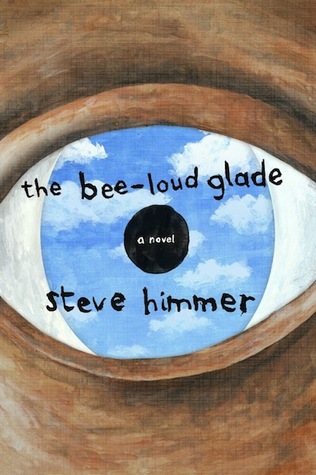
The Bee-Loud Glade


The Bee-Loud Glade by Steve Himmer
Published:  2011 by Atticus Books
Source:  Purchased

  It's been a while since I've mentioned the Books on the Nightstand Reading Retreat that I attended in April (best weekend ever), but after reading The Bee-Loud Glade I felt it deserved one more shout-out because without the retreat it is likely that I would have never picked this book up and that would be a shame.

  The Bee-Loud Glade tells the story of Finch, a man of undetermined age (though probably between 25-35) who, after losing his job at Second Nature Modern Greenery falls into a funk and among other things starts answering spam e-mail he receives.  One of these e-mails is an employment ad:

Are you a quiet, contemplative nature enthusiast available for full-time employment?  This is the opportunity you have been waiting for and thought would never arrive.  We offer a competitive salary and excellent benefits, including all lodging and meals.  Daydreamers and introverts encouraged to apply.  May we assume you are interested?

  A knock on his apartment door some days later starts Finch on his new career path as a decorative hermit in the gardens of Mr. Crane, a man with apparently too much money on his hands and who is running out of ways to spend it. 

  For an absurd amount of money (held for him until the end of his "employment" term of seven years), Finch is required to live in a cave in the garden, perform duties as requested by Mr. Crane, stop shaving, and stop talking.  As this was not a lot different from what Finch was doing in his period of unemployment, he takes the position.

  Of course things aren't all cut and dry -- there wouldn't be much of a novel if they were.  Finch has some trouble with the true hermitic life at first, and Mr. Crane finds some very odd tasks for him to perform in order to remain amused.  And, in alternating chapters right from the beginning of the novel, we see Finch as the hermit later on -- which not entirely explained, creates more questions that probably needed a longer book to answer. 

  The Bee-Loud Glade is definitely a quirky book that might not be everyone's cup of tea, but I enjoyed it and as I mentioned it definitely would not have been a book I picked up on my own.  If you have ever worked in a corporate environment,  though, you will likely find something to relate to in Finch.

  Recommended.

Tuesday, May 10, 2011

The Revenge of the Radioactive Lady


The Revenge of the Radioactive Lady by Elizabeth Stuckey-French
Published:  2011 by Doubleday
Source:  Purchased

  During the Cold War, a pregnant Marylou Ahearn was an unaware participant in a top secret study about the effects of radioactivity.  The effects of the study -- physical and emotional -- took a few years to arise, and Marylou never could quite move beyond it.  So, at the age of 77, she decides to take matters into her own hands and sets out to kill the doctor who ran the study.

  Such is the premise of The Revenge of the Radioactive Lady.  What Marylou doesn't know, however, is that the doctor, Wilson Spriggs, is suffering from dementia and lives with his daughter and her family; all of whom have their own issues.  She moves into the neighborhood, takes on an alias, Nancy Archer (from the cult film Attack of the 50 Foot Woman) and works her way into the family; she doesn't feel right killing Spriggs if he is not aware of the reason why, so she intends to hurt his family as she believes he hurt hers.

  I have to say that after reading Elizabeth Stuckey-French's short story collection The First Paper Girl in Red Oak, Iowa, I had doubts about this novel, because the short stories did not interest me.  But I was pleasantly surprised; Radioactive Lady is a quirky novel with some interesting (at times, weird) characters that also says something about family bonds (love them or hate them, they are still your family).  I thought part of the ending was a bit of a stretch, but otherwise this was a very enjoyable novel.

Highly Recommended

Tuesday, April 19, 2011

Paris Was Ours -- Review and Giveaway!

Published:  2011 by Algonquin Books of Chapel Hill
Source:  Purchased a copy, won a copy

  I have only had the good fortune to visit Paris once, for a brief 5 day visit, and I loved it.  I did the tourist-y things -- The Louvre, The Eiffel Tower, etc., but one of the greatest pleasures was just walking along the streets and enjoying whatever unexpected experience I encountered. (I remember one Sunday afternoon spending an hour or so in The Place des Vosges - a park in the Marais district - and felt like I was in Heaven).

  So Paris Was Ours was an essential purchase for me when it was published.  This collection of 32 essays is not about tourist Paris but about living in Paris (at different periods in recent history); and while the essays reinforce in Francophiles like me the greatness of Paris, they also show the not-so-pretty aspects of the city.   And while Paris is by no means the perfect place, its flaws do not seem to prevent these writers from staying there for an extended period time - if not permanently - or visiting again and again.

  Very few of the contributors of this collection were familiar to me (David Sedaris and Diane Johnson were the only names I recognized), but despite this I read each essay with my limited experience of Paris in mind and after finishing the book it was all I could do to not book myself an immediate flight (I'm hoping to visit Paris at the end of the year, but it's still in the wishing stage).

  And I loved this book so much I found myself with two copies!  I purchased the book on my own, but a few weeks ago I also won a copy courtesy of Wonders and Marvels, a really interesting and entertaining history blog.  So I'd like to send my extra copy to an interested reader.  Simply comment below (with an e-mail address, please) and for my own curiosity, tell me something that you like about Paris.  The giveaway is open internationally, and I will randomly select the winner on Monday, April 25. 

Highly recommended.

Thursday, April 14, 2011

Molly Fox's Birthday


Molly Fox's Birthday by Deirdre Madden
Published:  2008 by Picador
Source:  Purchased

  This novel is similar to James Joyce's Ulysses because:
  • It is set in Dublin (though there are some scenes in London)
  • It takes place over the course of one day
  • Something else that if I mention it, it would be a mild spoiler for this novel (I don't think there are opportunities for spoilers in Ulysses!).  It's not a spoiler in the truest sense, but if I knew about it I think I would have had a different experience reading the book.
  This novel is different from Ulysses because:
  • It's readable (yes, I have slogged through Ulysses so I know of what I speak)
  • It's about 500 pages shorter (probably contributing to the readable point)
  • The main character is female
  It's funny how the first thing I thought about after finishing Molly Fox's Birthday is the similarities to Ulysses.  And a bit weird, I know.
 
  So it's Molly Fox's birthday (specific date unmentioned -- another departure from Ulysses), but the main character is actually one of her oldest and closest friends:  A playwright who is staying in Molly's Dublin home (and who frankly I can't remember being named at all in the book) while Molly, an actress, is in New York.  As she goes about her day, the friend thinks back on her relationship with Molly and with others that have walked through her life, as well as encountering people who call at the house to wish Molly well (her birthday has been announced in the newspapers).

  The inside flap describes the novel as "... about a turning point - a moment when past and future suddenly appear in a new light."  I didn't get this, but apart from that I found it to be an enjoyable book.  I didn't love it, but I'm glad I read it.

Wednesday, April 6, 2011

The Tortilla Curtain


The Tortilla Curtain by T.C. Boyle
Published:  1995 by Penguin Books
Source:  Purchased

  I am at a loss to explain this book.  It is well-written, but difficult and disturbing; and despite being published in 1995, the story feels like it could have been written right now.

  The story follows two couples:  Delaney and Kyra Mossbacher, living in an exclusive community in the Los Angeles area; and Candido and America Rincon, Mexican immigrants who live (camp out, really) in the surrounding canyons, surviving day to day with whatever they can scrounge.  Both couples are ultimately working toward the same thing - the "American Dream", whatever that may be - but the author dramatically describes how different the paths are.

  Illegal immigration is the underlying theme in this novel, and it was frankly difficult for me to read both the passages of what the Rincons endured to try to make a better life for themselves and of the narrow-mindedness of the middle-class represented in this novel.  Sadly, I believe that what was described is closer to truth than to fiction and T.C. Boyle does not provide any answers to the problems encountered (rather, he does not provide lasting solutions)  At the same time, the descriptions of the Southern California landscape are quite beautiful, even for me who is not a nature-type person and frankly not a fan of life in Los Angeles (based on my few business trips to the area)

  With the right group (i.e. one that can promote civilized discussion) I think this would be a wonderful book to talk about with others. 

   Recommended.

Thursday, March 31, 2011

The Great Typo Hunt


Published:  2010 by Crown Publishers
Source:  Purchased

  I work for a company that sells its products by catalog, and one of my (many) responsibilities is to proofread said catalog before it heads to the printer each quarter.  Officially, I am only supposed to ensure item numbers and prices are correct, but I take it upon myself to also read through all of the copy to find any mistakes in spelling and/or punctuation (and since we sell equipment and supplies to auto body shops, the copy is not the most interesting reading, let me tell you).  Yeah, people might not notice if it's should really be its in a sentence, but I notice, and it bugs me when it goes uncorrected.

  So it goes without saying that I loved The Great Typo Hunt

  Jeff Deck is a twenty-something with an ordinary desk job.  He attends his college reunion and, since the college is Dartmouth, listens to the many noble accomplishments of his classmates while lamenting the lack of his own.  After some thought he decides to take a road trip across the United States to raise awareness of typographical errors and to correct them whenever possible.   He is joined by several friends throughout the journey, but Benjamin Herson is his primary sidekick.

  So they go about the country, searching for typos.  When they find one, they ask permission to correct it, and are met with a wide range of responses - from apologetic to downright hostile.  Through it all they also offer some thoughtful insight into the power of written communication and how much correct spelling does matter.

  The road trip took place in early 2008, at the beginning of the United States Presidential election campaign.  The guys were in Atlanta and noticed a typo on a t-shirt supporting Barack Obama.  They politely mentioned it to the shopkeeper, who was embarassed and promised to fix it before the next production run.  The discussion then turned to the impact of race in the campaigns, and afterward Deck thought:
Slavery had been abolished from the United States a bare hundred and fifty years ago; segregation, not even fifty years ago! ... The scars were fresh, some of them still oozing.  Factors like typos could only infect the wounds.  In 2002, for instance, an African-American spokesman for the Congress of Racial Equality appeared on MSNBC.  His name was Niger Innis.  Picture the worst way you could misspell his first name onscreen.  Yeah, that actually happened. ... these errors were, I'm sure, completely unintentional, but they - and the outrage that followed each incident - speak to the dangers of carelessness ... 
Now I'm a good speller, but reading this was further motivation for me to check my writing every single time.

  Another civics lesson - a significant one - comes to pass for the primary members of TEAL (that is, the Typo Eradication Advancement League), one that I can't really understand, but I guess I'm not surprised by it either. 

  Yes, the problem of typos isn't the biggest one our world is facing at the moment, but it was entertaining to read about the efforts of these guys to make typos relate to those more important things. 

Highly recommended.

(And I have checked this post three times for errors and made corrections, but if you've found one that I've missed, please let me know!)

Wednesday, March 23, 2011

Breakfast with Buddha by Roland Merullo


Breakfast with Buddha by Roland Merullo
Published:  2007 by Algonquin Books of Chapel Hill
Source:  Purchased

  This is a great book to read when you want or need a little laugh and a some philosophizing at the same time.

  After the tragic death of his parents, Otto Ringling must head to his hometown in North Dakota to settle their affairs.  Planning to take the trip with his off-beat sister Cecelia who is afraid of flying, he drives from his home in suburban New York pick her up at her place in New Jersey; only when he arrives she lets him know that she is not going but her spiritual guru, Volya Rinpoche, will accompany him and would Otto mind showing him some of the United States along the way?

  It's a bizarre pair of travelling companions, and the metaphorical journey they take is predictable (I thought it was, anyways) but that didn't make the story any less entertaining.  I loved this story and how Otto learned from Rinpoche, and Rinpoche learned from Otto; and the adventures that they had on the road. 

  This is one of my books selected for the 2011 TBR Pile Challenge.  I picked it up two or three years ago at The Norwich Bookstore in Norwich, Vermont, essentially just to purchase something.  I wish I would have taken it off my shelf before now, because it is a wonderfully enjoyable book to read.

Recommended.


Wednesday, March 16, 2011

The Gathering by Anne Enright


The Gathering by Anne Enright
Published:  2008 by Vintage Books
Source:  Purchased

  I purchased this book in 2009 while visiting Dublin (and thus is one of my selections for the 2011 TBR Pile Challenge).  Despite it being awarded the Booker Prize in 2007, I had not heard of it, but since it's an Irish novel and I was in Ireland, I picked it up.

  The back cover synopsis interested me as well:

  The nine surviving children of the Hegarty clan gather in Dublin for the wake of their wayward brother Liam.  It wasn't the drink that killed him - although that certainly helped - it was what happened to him as a boy in his grandmother's house, in the winter of 1968
The Gathering is a novel about love and disappointment, about thwarted lust and limitless desire, and how our fate is written in the body, not in the stars

  After reading the novel, I find that this blurb is very misleading (but, hey, it did its job and got me to buy the book).

  The primary voice of the novel is Veronica, Liam's younger sister and his closest sibling (chronologically and emotionally).  While there is a wake for Liam and there is a revelation of what happened to him at his grandmother's house, these points of the story to me seemed secondary.  Veronica is the main character.

  Veronica is the one to break the news of Liam's death to her mother.  Veronica travels to England to claim his body and return it to Ireland.  As she goes about these solemn duties, she is remembering her brother and the good and bad times; remembering the incident at her grandmother's house (which, by the way, though tragic, did not seem to be enough to affect Liam so dramatically) and visualizing the life of her grandmother as a young woman, all the while realizing that her marriage is in trouble.

  I have to say that I did not like this book; partly because it wasn't what I expected, but also because I couldn't like any of the characters.  I couldn't feel sorry for Liam, there wasn't much to Veronica even though she dominates the novel, and there weren't any aspects to anyone else to draw attention.

  Another disappointing impulse purchase.  I wish I could say that I've learned my lesson, but we all know otherwise......

  Have you read this novel?  What were your thoughts on it?

Thursday, March 10, 2011

A Man in Uniform


A Man in Uniform by Kate Taylor
Published:  2010 by Crown Publishers
Source:  Borrowed from the library


  Francois Dubon is a relatively successful lawyer in Paris, has a wife with the "right" social connections, and a mistress on the side.  One day, a woman in widow's mourning comes into his office and, acting on behalf of a "friend", asks him to prove the innocence of Captain Alfred Dreyfus, a French military officer (who is Jewish) convicted and imprisoned for espionage.

  The Dreyfus Affair, as it is known, is one of the most scandalous events in France's history.  Mixing real-life personalities with her characters, Kate Taylor has created a suspenseful novel about events in the latter stage of this period; so that even though we know how events really turn out, the reader isn't always quite sure if Dreyfus will be exonerated.

  Once again I loved the descriptions of Paris -- this time of the late 1800s -- and enjoyed learning more about this period of France's history and how it affected life and society during that time.

Recommended.

Tuesday, March 8, 2011

Of Hockey and Hijab


Published:  2009 by Coach House Printing
Source:  Purchased

  This book is a collection of essays that initially appeared in The Globe and Mail as a series of monthly columns that Ms Khan wrote for the newspaper as a means to bridge the gap of understanding between Canadians as a whole and the Islamic community.  Written between 2002 and 2009, one would think that some of the material would be dated now, in 2011, but I found them quite timely.

  In an essay about reform in the Muslim world, she writes:

The wretched conditions faced by Muslims will not cease until there is a fundamental change from within

 and
Muslims will not solve homegrown problems of corruption, illiteracy, and sectarianism by constantly blaming the West.

  Declarations that now, given recent events in Tunisia, Egypt and Libya seem almost prescient. 

  Included are also some personal essays that I found wonderfully poignant.  One tells about taking her son to a Montreal Canadiens' game and the memories it evoked of her childhood love of the team and of the game; this wasespecially enjoyable for me -- I was a long-suffering Winnipeg Jets' fan before they moved to Phoenix and though I hated the Canadiens I think I would have enjoyed attending a game with Ms Khan.  There is also a lovely tribute to a family neighbor, a Jewish woman, and the sadness that came at her death a few days before Khan's wedding:

And I wanted her to be part of the celebration the following day.  She was just like family.


  Overall I found this essay collection enlightening and look forward to reading more from Ms. Khan.  I know so little about Muslims and of their faith and books like this provide a personal side that is sadly lacking in news coverage.

  Highly recommended


Sunday, March 6, 2011

The Paris Wife


The Paris Wife by Paula McLain
Published:  2011 by Ballantine Books
Source:  Advance Copy received from the publisher

  First of all, a confession:  I have never thought I would like Ernest Hemingway.  I think I read one or two of his books long ago but I didn't get anything out of them; and he has always struck me as a macho guy without anything to say that would be relevant to me.

  That might still be true, but after reading The Paris Wife, I am willing to try him again.  This novel is not about Hemingway himself so much as it is about his first wife, Hadley.  The two met in Chicago in 1920 and after their marriage, they moved to Paris where Hemingway struggled with his writing and Hadley gave him the time and space he needed.  Their marriage was by no means ideal and who knows if it would have fared any different if they remained in the United States, but this novel portrays Hadley for the most part as a woman standing by her man through thick and thin, despite the effects on her own aspirations and well-being.  That is not to say she was a weak woman; despite her love and loyalty to Hemingway she did very well standing up to him.

  Of course, as a francophile I also loved the descriptions of 1920s Paris, and the atmosphere of that era really came through.  And the description of Hemingway's writing process - especially the genesis of the novel The Sun Also Rises has made me want to read this book and see if my attitude toward his writing has changed.

  Recommended